Aemon Targaryen
Fire & BloodAemon Targaryen, Prince of Dragonstone, was the eldest son of Jaehaerys I Targaryen and Alysanne Targaryen, and for most of his life the acknowledged heir to the Iron Throne. He grew from a publicly celebrated royal infant into a knight, dragonrider, and master of laws, embodying the stability his father’s succession appeared to promise. His death on Tarth in 92 AC abruptly ended that promise and raised the question of whether his daughter Rhaenys, or her unborn child, should inherit in his place.
Birth and Childhood
Aemon was born in 55 AC, after Jaehaerys returned from a progress through the Westerlands in time to be present for the birth. The boy was healthy, with pale lilac eyes and pale hair that shone like white gold. His parents named him Aemon, and Alysanne placed a dragon egg in his cradle that night. When the royal family returned to King’s Landing a moon’s turn later, thousands of smallfolk gathered outside the Red Keep hoping to see the new prince. Jaehaerys eventually raised his son above the gate’s ramparts, presenting the child to the crowd as the heir whose birth had stirred the realm’s hopes.
Aemon’s earliest family life placed him beside his sister Daenerys and, later, his younger brother Baelon. Jaehaerys spoke of Aemon as his heir from the moment he was born, a preference that displeased Alysanne. She maintained that Daenerys, as the elder child, should be queen; Jaehaerys’s answer was that she would rule alongside Aemon as his wife. The plan did not come to pass, but it reveals that the king imagined Aemon’s future not simply as succession, but as a joint rule modeled on his own marriage.
Aemon and Baelon became exceptionally close. Baelon followed his elder brother everywhere and copied his activities, including trying to join his arms training before he was old enough. When Aemon was given a wooden sword, Baelon made one from a stick and rushed into the yard to spar with him. Their affection was visible in their companionship and in a spirited rivalry that lasted as they grew older. The bond mattered to the realm as well as to the family: older lords remembered how the sons of Aenys and Maegor had turned against one another, and Grand Maester Benifer watched the brothers with that history in mind. Aemon and Baelon, by contrast, were described as closer than almost any brothers.
Heir, Knight, and Dragonrider
In 62 AC, when Aemon was seven, Jaehaerys formally named him Prince of Dragonstone, confirming him as heir to the Iron Throne. His investiture gave public form to the expectation established at his birth. At the feast afterward, Aemon was seated beside Jocelyn Baratheon, daughter of the late Queen Alyssa Velaryon. The two were observed talking and laughing together, an early sign of the match that would later unite them.
Aemon distinguished himself in arms as a young man. At a tourney in Duskendale in 72 AC, he won the squire’s melee, defeating Baelon in one of their contests, and later impressed in the lists. He was knighted at seventeen. After returning to King’s Landing, he became a dragonrider, taking Caraxes, a blood-red dragon known to the Dragonkeepers as the Blood Wyrm. His military promise was accompanied by a reputation for ability in peaceful government, so that the two brothers together seemed to offer the realm both a secure succession and capable leadership.
In 81 AC, at the age of twenty-six, Aemon took on a formal role in the king’s council. Jaehaerys appointed him justiciar and master of laws, replacing Rodrik Arryn. The appointment recognized the heir’s capacity to participate directly in governing the realm, rather than leaving his position as a matter of title alone. Aemon did not become Hand of the King; that office belonged to Septon Barth, whom Jaehaerys regarded as his trusted companion in the work of rule.
Marriage and Family
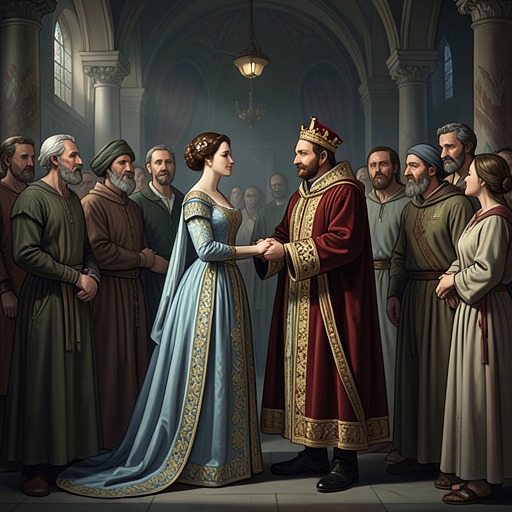
Aemon’s betrothal to Jocelyn Baratheon was announced in 68 AC. After the death of Daenerys, there had been consideration of marrying Aemon to his sister Alyssa, but Alysanne rejected that arrangement and intended Alyssa for Baelon instead. Aemon and Jocelyn married in 70 AC, in a ceremony described as rivaling the splendor of the Golden Wedding. Aemon was fifteen and Jocelyn sixteen. Their union joined the royal heir to House Baratheon, and the couple had a daughter, Rhaenys, born in 74 AC.
Rhaenys became central to the succession after Aemon’s death. At sixteen, in 90 AC, she married Corlys Velaryon, the king’s admiral and master of ships, known as the Sea Snake. When Aemon was killed two years later, Rhaenys was pregnant. His death therefore left not only a widow and an existing daughter, but also the possibility of a male grandchild who might have been considered for the Iron Throne.
Death on Tarth and the Succession
In 92 AC, Aemon joined the campaign to drive Myrish forces from Tarth. The Sea Snake and the Velaryon fleet sailed first to protect the crossing of Boremund Baratheon and his stormlanders; Aemon followed, leaving Jocelyn and Rhaenys behind. Rhaenys had recently learned that she was expecting and had not accompanied her father. Aemon met the Evenstar of Tarth, Lord Cameron, in a concealed valley where the two planned their response to the Myrish movements. Caraxes was with them.
The camp’s position was discovered by two Myrish scouts. One recognized Lord Cameron and fired a crossbow bolt from concealment, aiming at the Evenstar. The shot missed Cameron and struck Aemon, who died at thirty-seven. Aemon’s death was accidental in its immediate target, but decisive in its political effect: the king had lost his eldest son, the named heir, and a councillor trusted with the law.
Baelon responded by flying to Tarth on Vhagar and taking part in the campaign that drove the Myrish from the island. When he returned to King’s Landing with Aemon’s body, Jaehaerys named him Prince of Dragonstone and heir to the Iron Throne. The appointment was popular: the smallfolk admired Baelon, and many lords regarded him as the obvious successor. Yet it also passed over Rhaenys and, potentially, the child she carried. Jaehaerys’s choice followed established male-preference practice and the council’s view that Baelon, a seasoned knight who had already fathered two sons, was better suited to rule than Rhaenys or an unborn child. Aemon’s family loss thus became a constitutional turning point, exposing the difference between a settled succession in appearance and the competing claims that could emerge when its chosen heir died.
Significance
Aemon’s life is presented through the contrast between promise and interruption. His birth was made a public celebration; his childhood with Baelon suggested that the succession would avoid the fraternal conflict remembered from an earlier generation; and his knighthood, dragonriding, and appointment to the council gave substance to his expected future as king. His death, caused by a bolt meant for another man, overturned that orderly prospect in an instant.
The consequences extended beyond the immediate grief of Jaehaerys, Alysanne, Jocelyn, and Rhaenys. Baelon’s elevation answered the need for a living, experienced heir, but it also left Aemon’s daughter and unborn grandchild outside the succession. Aemon therefore stands at the hinge between a seemingly secure line of inheritance and the later dispute over whether birth, sex, experience, or political acceptance should determine who ruled.